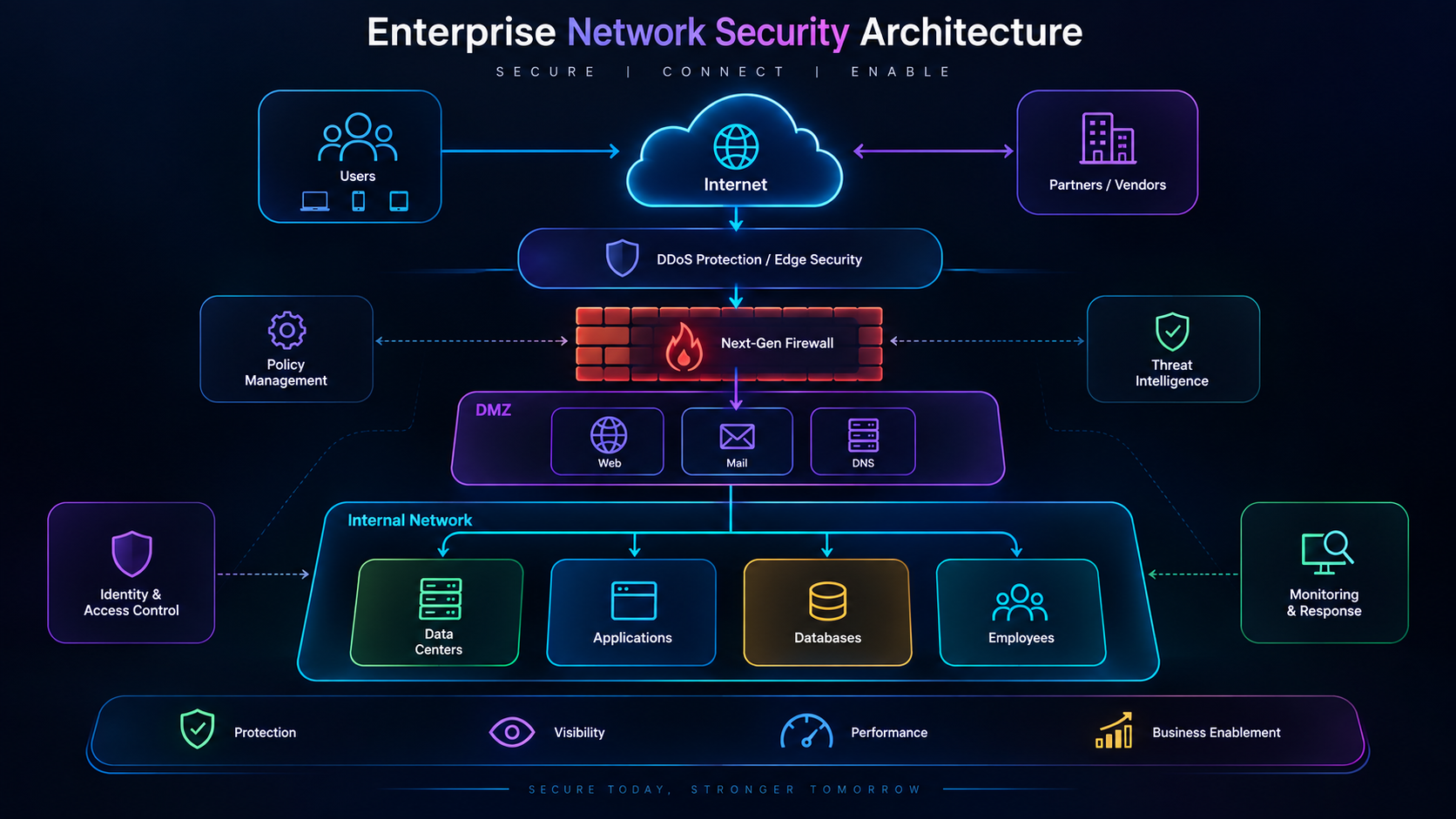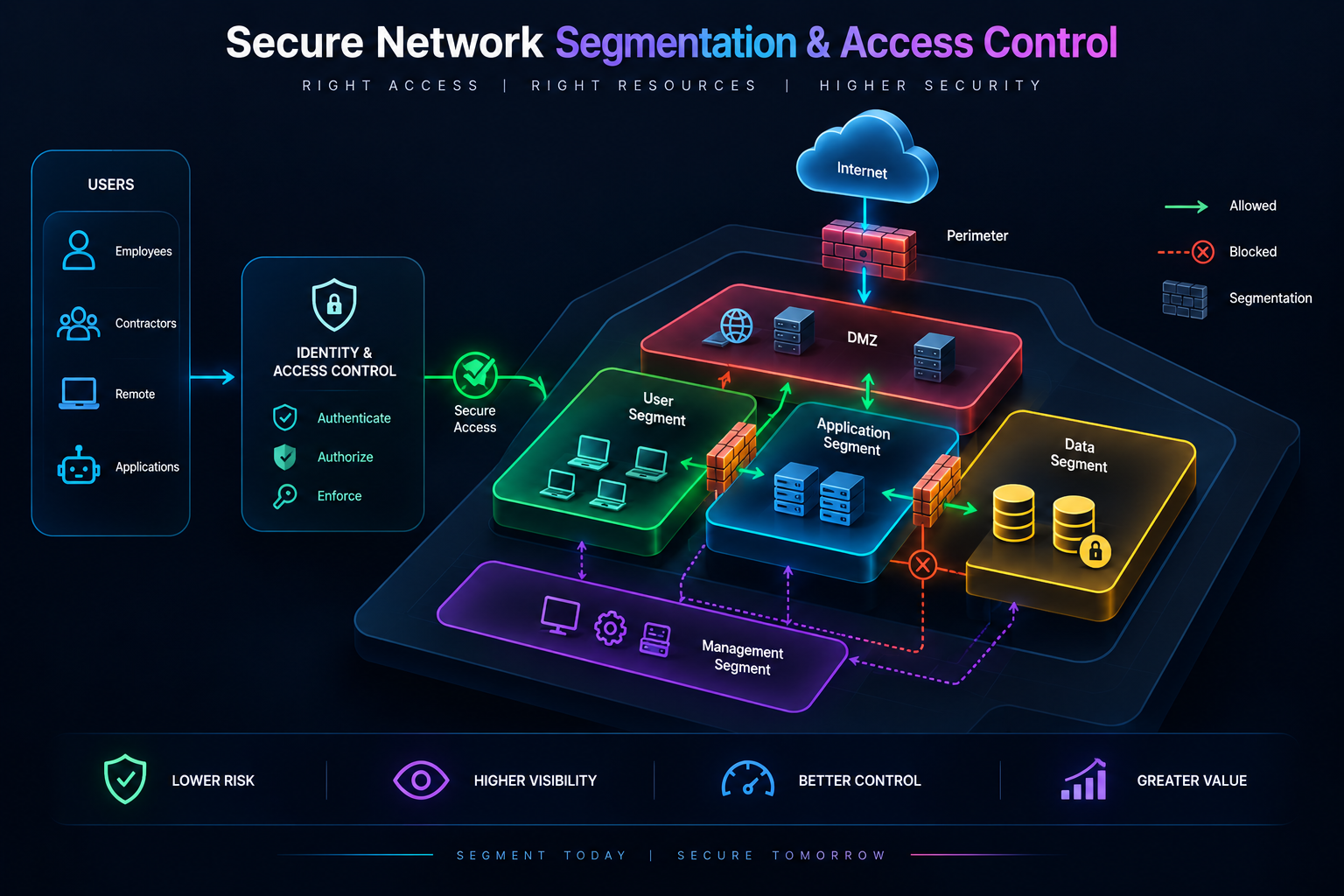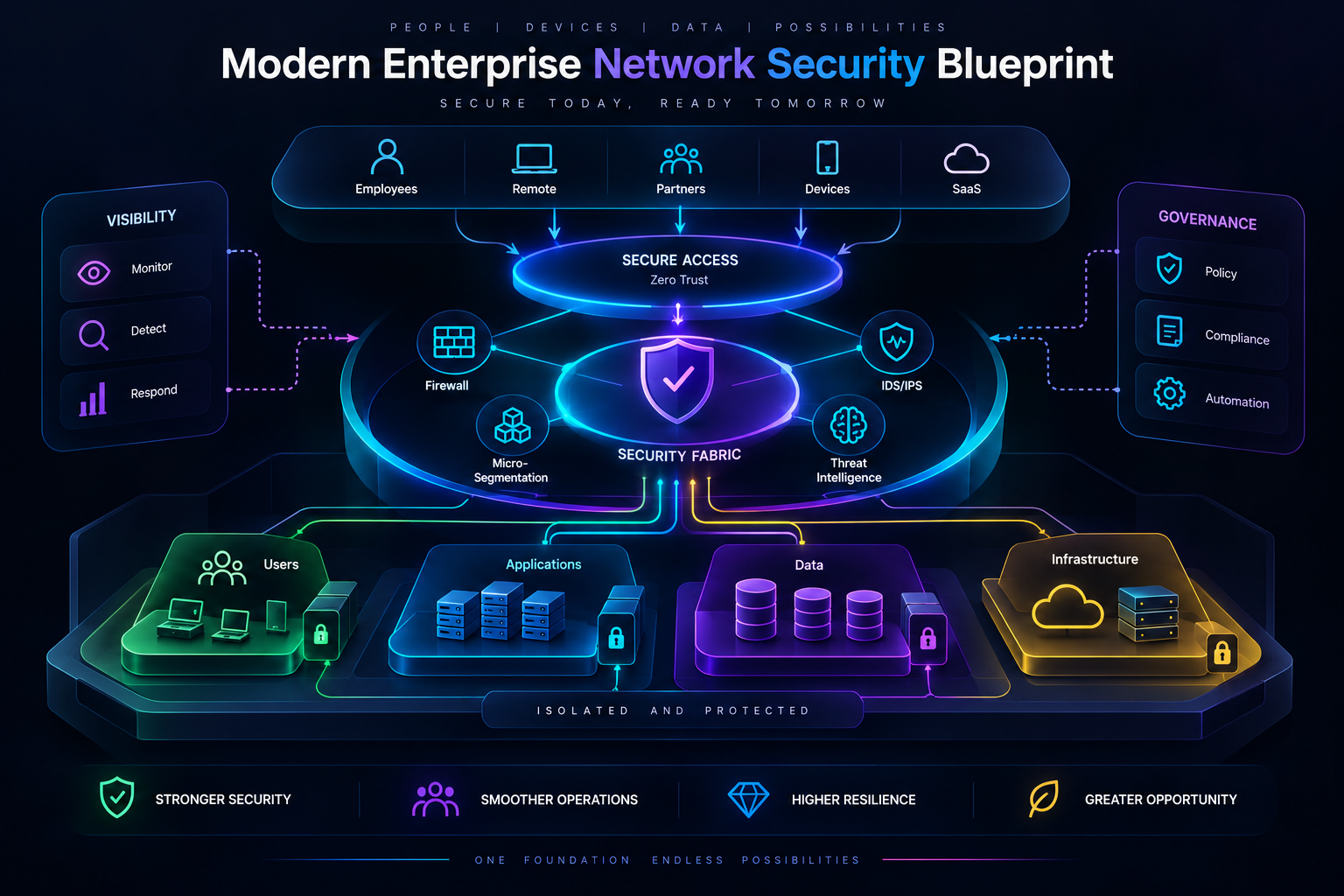

Cylentrix designs and implements secure, resilient network architectures that protect users, applications, data and infrastructure across enterprise, branch, cloud and remote environments. Our network security architecture services bring secure network design, segmentation, access control and monitoring into a single connectivity model, so enterprise network security is engineered into the network rather than added to it later.
Network security architecture is the design that decides what traffic is possible before any security product is switched on. Everything installed afterwards works inside the boundaries that design creates.
Network security is not only about deploying security appliances. Where those appliances sit, which traffic they can actually see and what they are permitted to control are architectural decisions, made long before anything is racked or licensed. A well configured firewall on the wrong boundary still leaves the path it cannot see wide open.
A secure network architecture considers users, applications, workloads, devices, data, connectivity, access, traffic flows and security policies as one design rather than as separate projects. That is what turns a collection of products into enterprise network security.
Cylentrix helps organisations design network environments where security, connectivity, performance and scalability work together. We start from how the business actually operates, then structure the network so that protection, visibility and growth are all supported by the same architecture.
Security requirements shape the network topology, routing and policy structure instead of being retrofitted onto a design that never expected them.
Users, devices and workloads reach only the systems their role requires, with access decided at defined points rather than inherited from the network they happen to sit on.
Traffic between zones, sites and cloud environments passes points that can inspect, log and report it, so activity can be reviewed rather than assumed.
New sites, cloud workloads and applications extend an existing pattern instead of triggering another one-off design that adds complexity.
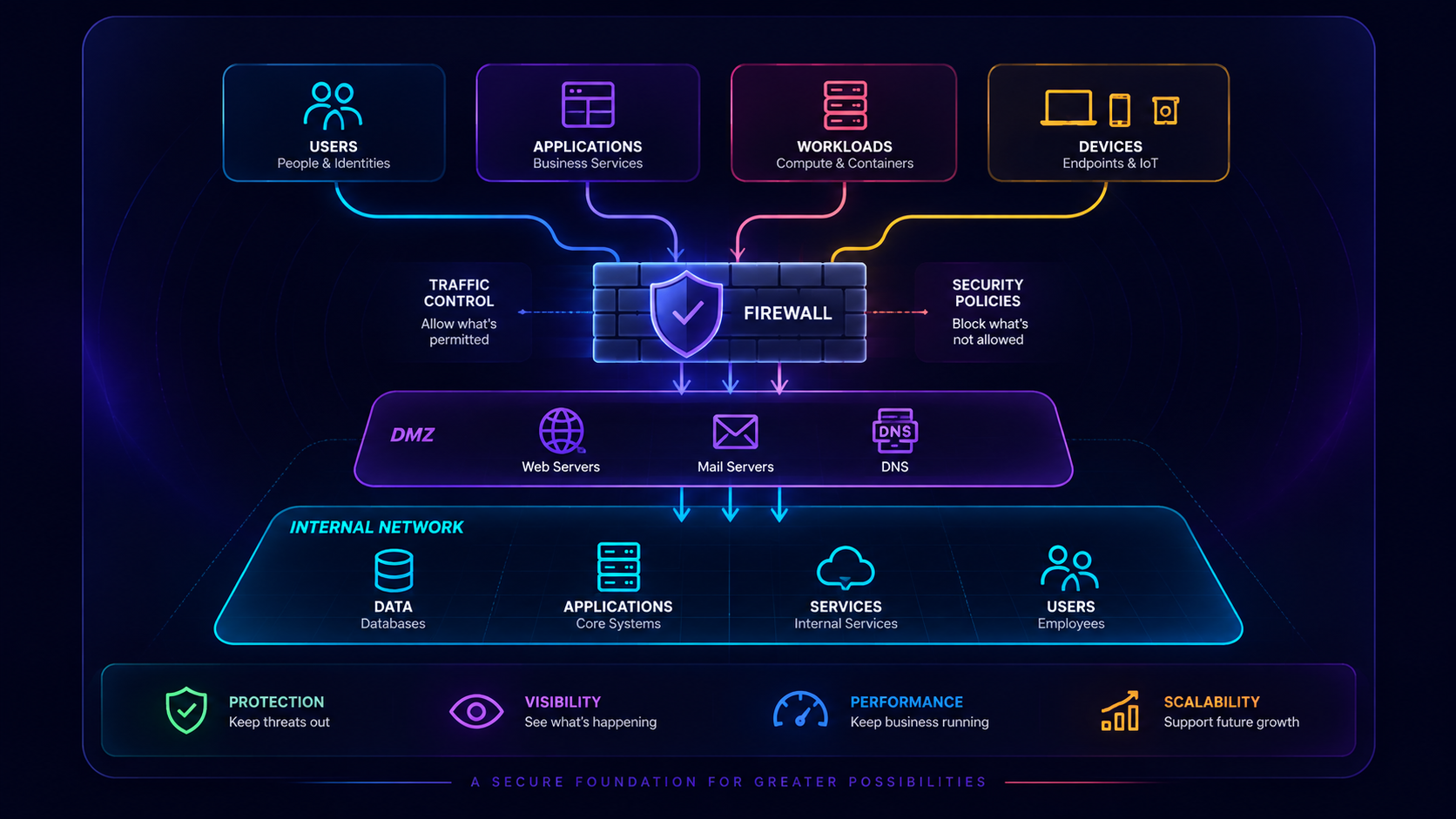
Network architecture services covering design, segmentation, access, cloud and data center connectivity, delivered as one coherent secure network architecture rather than a set of disconnected deployments.
Network architectures aligned to business, security and connectivity requirements, documented so the design intent survives the next change.
Users, applications, workloads and critical systems separated into controlled segments so that access reflects need rather than proximity.
Logical security zones with defined trust levels, and explicit rules for which traffic flows are permitted between environments.
Firewall placement, traffic paths and policy structure designed as part of the wider architecture, not as a standalone appliance project.
Connectivity for remote users, branches and distributed teams designed so people reach the applications they need and nothing beyond them.
Secure connectivity and consistent controls for cloud-connected environments, covering routing, virtual network structure and policy alignment.
Security built into data center connectivity, workload separation, management networks and the paths that reach critical infrastructure.
Visibility into network traffic, connections and security events, with collection points designed into the architecture rather than added later.
Network security implementation on a live enterprise network is a sequence, not an event. Each stage is agreed before the next one touches production traffic.
Understand the current network, applications, users, traffic patterns and security requirements.
Define the target security architecture and the overall connectivity model it depends on.
Develop network zones, traffic flows, access controls and the security policies that govern them.
Deploy the agreed architecture and security controls in a controlled, staged manner.
Test connectivity, security policies, segmentation and expected traffic behaviour before sign-off.
Review the environment and improve performance, security and scalability as requirements change.
Segmentation boundaries, access rules and traffic flows look different in a plant, a hospital and a trading floor. Cylentrix designs enterprise network security around how each sector actually runs.
Core banking, payments and trading zones stay separated from branch, corporate and vendor networks.
Clinical systems, medical devices and admin networks are segmented so patient data paths stay narrow.
Plant floor and corporate IT are separated, with controlled crossing points between the two.
Development, delivery and client environments run in distinct zones with per-client isolation.
Citizen-facing services, internal systems and inter-department links get defined trust levels.
Store networks keep payment systems, back-office access and in-store devices apart.
Student, staff, research and campus device networks each get their own zone and access rules.
Warehouses, hubs and handheld devices connect through one consistent, controlled branch design.
Workload separation, management isolation and controlled east-west paths are designed in early.
Guest Wi-Fi stays isolated from property management and payment infrastructure at every site.
Secure network architecture sits exactly where cybersecurity, IT infrastructure and connectivity meet. Cylentrix works across all three, so the design is made by people who will also have to run it.
One team covering cybersecurity, managed IT and telecom, so the architecture accounts for security requirements, infrastructure reality and the underlying connectivity at the same time.
We work on production networks that already carry the business, with the constraints, legacy segments and change windows that come with them.
Segmentation planned around applications, data sensitivity and operational dependencies, so boundaries improve security without breaking the systems that cross them.
On-premise, data center and cloud environments designed as one estate, with consistent routing, policy and control across the boundaries between them.
Policies written to match the architecture, documented in language the team can maintain, and structured so future changes do not quietly widen access.
We do not stop at a design pack. Our engineers configure, migrate and commission the architecture, then stay with it through validation and handover.
Branch, remote and third-party connectivity designed to the same standard as the core, so the edge of the network is not the weakest part of the design.
Architectures are reviewed as applications, cloud usage and business needs change, so the design keeps pace instead of drifting back into complexity.
Multi-region delivery for enterprises with sites and cloud footprints across geographies, working to one architecture standard and one point of accountability.
Cylentrix designs vendor-appropriate architectures and works with established networking and security technology providers to implement them.
Practical reference material from the Cylentrix network practice, written for the architects and IT leaders who have to live with the design.
Architecture Guide
How security zones, traffic flows and control points fit together in a modern enterprise network design.
Read the guide
Segmentation
A practical approach to planning segments, defining boundaries and phasing access control onto a live network.
Download the guide
Blueprint
A layered reference design covering campus, branch, data center, cloud and remote access in one architecture.
Read the blueprintThe questions IT and security leaders ask before committing to a network redesign, answered the way our network architects answer them.
Network security architecture is the design of how an enterprise network is structured so that security is built into connectivity itself. It defines security zones, segmentation boundaries, traffic flows, access control points, where security controls are placed and which policies govern movement between environments. It covers the network as a whole, including headquarters, branches, data centers, cloud environments and remote users, rather than any single security product.
Network security implementation typically includes assessment of the current network, target architecture definition, design of network zones and traffic flows, access control and security policy design, configuration and deployment of the agreed controls, migration planning, validation testing of connectivity and policy behaviour, documentation, and a period of tuning once production traffic is flowing.
Segmentation limits how far activity can travel inside a network. On a flat network, a single compromised device or account can reach a very wide range of systems. Segmentation separates users, applications, workloads, operational technology and critical systems into defined zones with controlled paths between them, which reduces unnecessary exposure, makes traffic easier to inspect and supports compliance requirements that expect sensitive systems to be isolated.
Yes. A modern network security architecture treats on-premise, data center and cloud environments as one connected estate. That includes cloud connectivity design, virtual network and subnet structure, security group and policy consistency, controlled routing between cloud and on-premise systems, and data center segmentation for workloads, management networks and critical infrastructure.
Remote users and branch offices are treated as defined entry points in the architecture rather than exceptions to it. That means designing secure remote access so users reach only the applications they need, applying consistent security policy at branch sites, controlling how branch traffic reaches the internet, cloud and the core network, and ensuring the same visibility and access control principles apply regardless of where a user connects from.
Firewalls, gateways, network access control, VPN and remote access platforms, monitoring tools and detection technologies are components within the architecture. The architecture decides where those controls sit, what traffic they can see, which boundaries they enforce and how their policies relate to each other. Without that design, individual products can be well configured and still leave unmonitored paths through the network.
Yes. Most engagements involve an existing production network rather than a new build. Cylentrix assesses the current design, traffic patterns, access paths and security policies, identifies where exposure and complexity have accumulated, and defines a target architecture that can be reached in controlled phases without disrupting business operations.
Cylentrix works across cybersecurity, managed IT and telecom, so network security architecture is designed by a team that understands connectivity, infrastructure and security together. We assess the current environment, architect and design the target state, implement the agreed segmentation, access controls and security policies, validate the result, and continue to optimise the architecture as applications, cloud usage and business requirements change. We support enterprises across India, the USA and Singapore.
Tell us what your network looks like today and what it has to support next. A Cylentrix network architect will review it and come back with a clear, practical view of where the design can be strengthened.
Design a network architecture that strengthens security, improves visibility and supports the changing needs of users, applications, cloud environments and critical infrastructure.