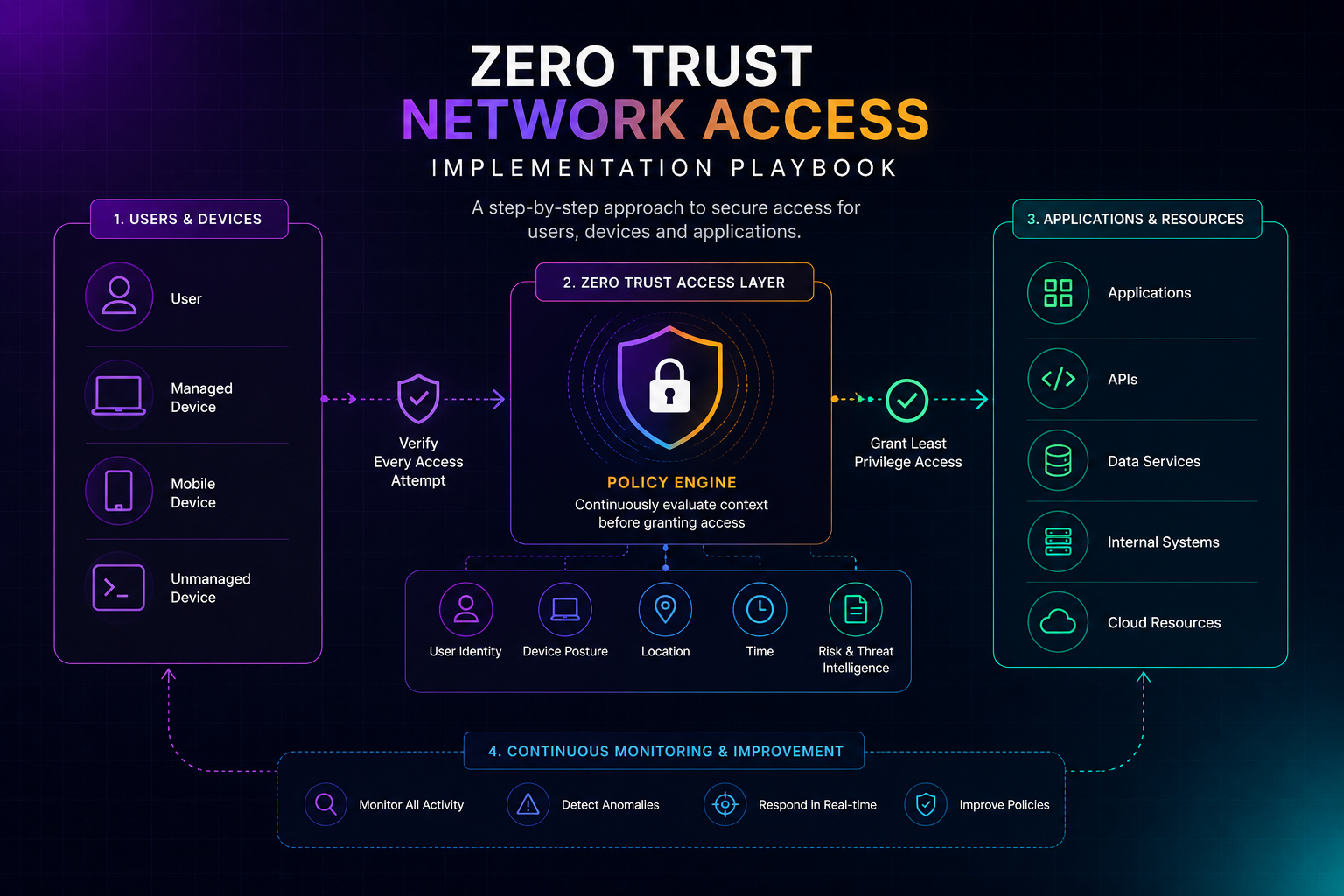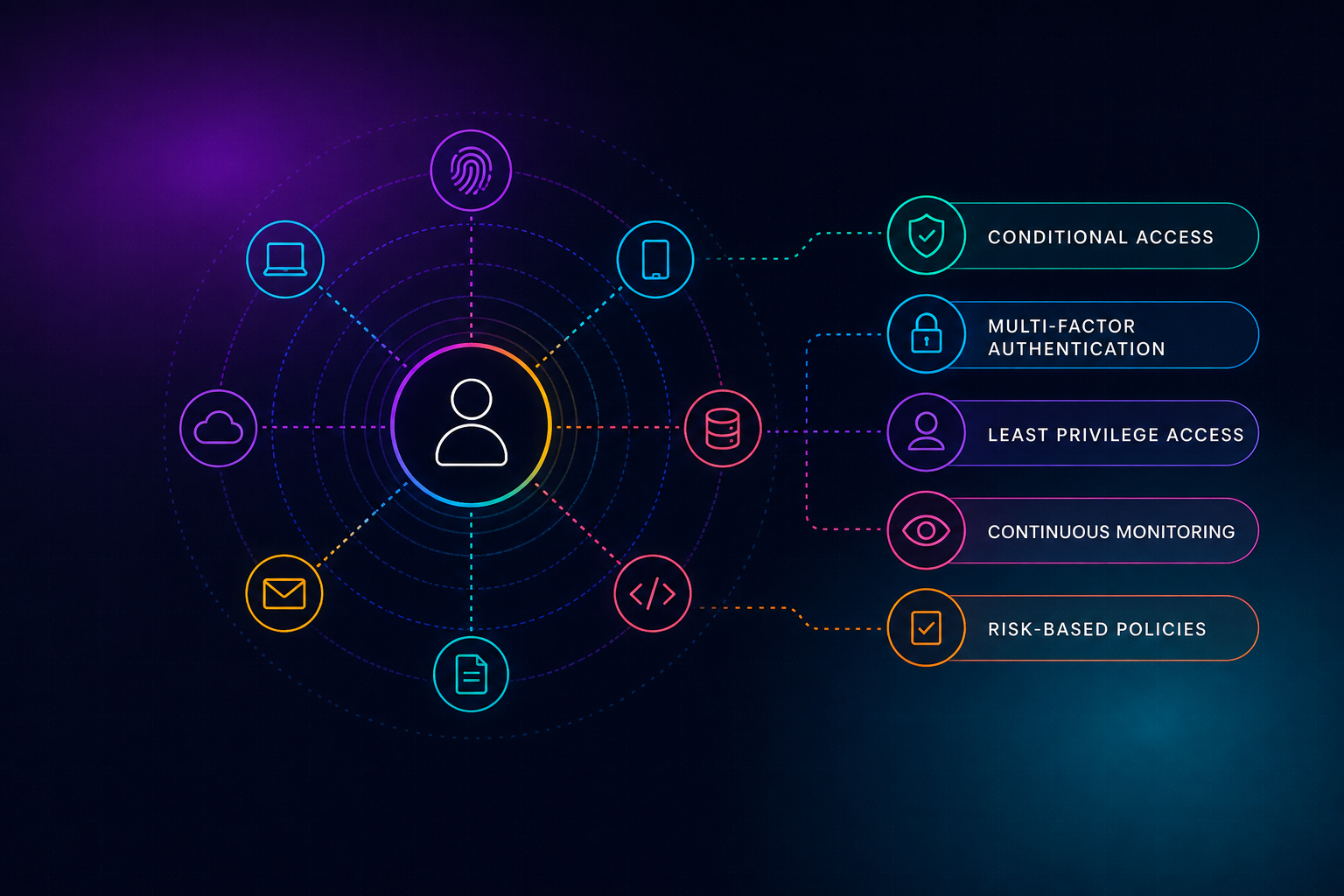
Build a security architecture based on continuous verification, least privilege access and contextual controls across users, devices, applications, networks and cloud environments. Cylentrix designs and implements enterprise Zero Trust, from identity-based security and Zero Trust Network Access (ZTNA) to micro-segmentation and continuous monitoring, on the infrastructure you already run.

Zero Trust Security removes implicit trust from the network. Being inside the corporate perimeter, on a company subnet or behind a VPN grants nothing on its own.
The operating principle of Zero Trust Architecture is simple: never trust, always verify. Every access request is treated as though it originates from an untrusted network, and is authenticated, authorised and encrypted before access is granted, then re-evaluated for the life of the session.
Cylentrix designs and implements that architecture end to end — identity first, then access, network and endpoint controls, delivered as one programme and operated continuously.
Signals evaluated on every access request
Maturity assessment against NIST SP 800-207, gap analysis and a phased implementation roadmap.
Identity-based security as the control plane: SSO, conditional access, lifecycle and access reviews.
Phishing-resistant MFA across workforce, admin and third-party accounts, with risk-based step-up.
ZTNA replaces broad VPN tunnels with per-application access, so users reach the app, not the network.
Workload and east-west segmentation across data centre, campus and cloud to contain lateral movement.
EDR and device-management signals wired into the policy engine, so posture is a live access condition.
PAM for admin and vendor accounts: vaulting, session recording and just-in-time elevation.
Identity, endpoint and network telemetry correlated in the SOC, with anomaly detection feeding policy.
Every request runs the same loop. The policy engine combines live signals into a decision, enforces it at the access point, and keeps re-evaluating for as long as the session lasts.
Resolve who and what is requesting access.
Authenticate the identity and the device together.
Score context, posture and behaviour in real time.
Issue the narrowest entitlement for this resource.
Watch the session continuously, not just at login.
Tighten, challenge or revoke as signals change.
Re-evaluated continuously for the life of the session
Modern enterprises run across cloud, SaaS, remote users, branch offices and third-party access. Zero Trust replaces a perimeter that no longer exists with controls that follow the request.
Micro-segmentation and least privilege access stop a single compromised endpoint from reaching file shares, domain controllers and databases it never needed. The blast radius shrinks to one workload.
Zero Trust Network Access publishes applications individually instead of placing users on the network. Remote staff, contractors and vendors reach only what their role requires.
Phishing, credential stuffing and token theft turn a valid login into the attack path. Phishing-resistant MFA and continuous session validation close that route without adding friction for every user.
Personal laptops, contractor machines and mobile endpoints are admitted on posture, not on trust. Device health becomes a live access condition rather than a quarterly report.
Behavioural analytics learn what normal looks like per identity and surface the deviations that matter, so access tightens on evidence and the gap between signal and response narrows.
Every decision is attributable to an identity, a device and a policy. Access reviews, segregation of duties and regulator questions are answered from records the architecture produces by design.
Wherever identity, regulated data or operational uptime is the crown jewel, Zero Trust Architecture is the control model. Cylentrix adapts the pattern to each sector's reality.
Segment OT from IT, broker vendor access to line systems, and keep engineering workstations off flat plant networks.
Least-privilege access to EHR and PACS, shared-workstation identity, and medical devices isolated from clinical records.
Privileged access to core banking, segregation of duties enforced in policy, and auditable trails for every regulated system.
Per-client isolation in delivery centres, ZTNA for engineers and contractors, and scoped access to source control.
Unmanaged student devices on campus networks, kept separate from research data, finance systems and staff records.
Store networks segmented from payment and back-office systems, with seasonal staff granted time-bound access only.
Handheld and yard devices verified before they reach WMS and tracking platforms, with partner APIs scoped individually.
Citizen data and inter-department links governed by explicit policy, with clearance-aligned, fully auditable entitlements.
East-west micro-segmentation between workloads, just-in-time admin access, and no standing routes between production tiers.
Guest Wi-Fi kept structurally separate from PMS and payment systems, with staff accounts revoked the day they lapse.
Zero Trust touches identity, endpoints, applications, the network and the WAN at the same time. Cylentrix runs all of those disciplines in-house, so the architecture is designed once and delivered as one programme.
Zero Trust fails at the seams between teams. We own security, infrastructure and connectivity together, so policy, routing and endpoint controls agree.
We start where attackers start. Directory hygiene, conditional access, MFA coverage and privileged accounts are addressed before anything else moves.
Data centre, campus, branch, cloud and legacy systems that cannot be replaced. We design Zero Trust around the estate you actually operate.
Our NOC and SOC practices already instrument traffic and devices, which gives the policy engine trustworthy signals from day one.
Reference designs aligned to NIST SP 800-207, translated into vendor-specific build standards, policy sets and migration sequencing.
Zero Trust is an operating model, not a project. Access, posture and anomalies are watched around the clock once the architecture is live.
Policy tuned to your risk appetite so controls hold without breaking workflows, measured on real access data rather than assumption.
Phased rollout across sites and business units, with pilot groups, fallback paths and change control, so nothing lands on users unannounced.
Multi-region delivery and support for enterprises whose users, data residency obligations and working hours span more than one geography.
Cylentrix is platform-agnostic. We design the Zero Trust architecture first, then implement it on the identity, network and endpoint platforms that fit your estate.
Practical guides from the Cylentrix security practice, written for the architects and IT leaders who will own the Zero Trust rollout.
Architecture
Reference architecture, control-plane mapping and a phased sequence for adopting Zero Trust without a rip-and-replace.
Read the guide
Playbook
Migrating from VPN to ZTNA: application discovery, connector design, policy modelling and user cutover in waves.
Download the playbook
Identity
Making identity the control plane: conditional access, MFA coverage, privileged accounts and least privilege access reviews.
Read the guideTell us where your users, applications and data sit today. A short conversation with a Cylentrix security architect — not a sales call. We will look at your identity provider, remote access, endpoint estate and segmentation as they stand, and tell you where Zero Trust will pay back first.
We reply within one business day.
Your details are used only to respond to this enquiry.
The questions security and IT leaders ask before committing to a Zero Trust programme, answered the way our architects answer them.
Zero Trust Architecture is a security model that removes implicit trust from the network. No user, device or workload is trusted because of its location; every access request is authenticated, authorised and encrypted, and is continuously re-evaluated against live signals such as identity, device posture, application sensitivity, location, context and risk. It is defined formally in NIST SP 800-207.
Traditional security defends a perimeter: once a user or device is inside, it is broadly trusted and can often reach far more than it needs. Zero Trust Security has no trusted inside. Access is granted per resource, per session, at the least privilege required, and is withdrawn when signals change. The unit of control moves from the network segment to the individual request.
Three principles carry the model: verify explicitly, using all available signals rather than network location; enforce least privilege access, scoped per resource and time-bound where possible; and assume breach, designing segmentation, monitoring and blast-radius containment on the expectation that some component will eventually be compromised.
Zero Trust Network Access is the access technology that implements Zero Trust for applications. A broker authenticates the user and device, checks policy, then creates an outbound connection to one specific application. The user reaches the application without being placed on the network hosting it, and unauthorised applications remain invisible rather than merely blocked.
For most remote-access use cases, ZTNA replaces VPN, because a VPN grants network-level access where ZTNA grants application-level access. In practice the transition is gradual: organisations typically run both, moving applications onto ZTNA in waves and retaining VPN for legacy protocols or site-to-site links until those are re-architected.
Remote access is treated exactly like any other request. The user authenticates with phishing-resistant MFA, the device is checked for management, encryption, patch level and endpoint protection, and access is issued to specific applications only. If posture degrades or behaviour becomes anomalous mid-session, access can be narrowed, challenged or revoked without waiting for the next login.
Yes. Zero Trust is an architecture, not a product, and it is normally built on what you already own. Existing identity providers, firewalls, EDR, MDM and SIEM platforms become the signal sources and enforcement points; the work is integrating them behind a consistent policy model and closing the gaps that remain.
Cylentrix begins with a Zero Trust assessment of identity, devices, applications, network and data, then produces a prioritised roadmap. From there we implement in phases: identity and MFA, ZTNA for applications, micro-segmentation, privileged access controls and endpoint integration, followed by continuous monitoring. Our cybersecurity, IT and telecom practices deliver it as one programme across India, USA and Singapore.
Build a Zero Trust security architecture designed around continuous verification, least privilege and adaptive risk controls. Tell us where your users, applications and data sit today, and we will map the gaps and the sequence to close them. Explore our full range of cybersecurity services.