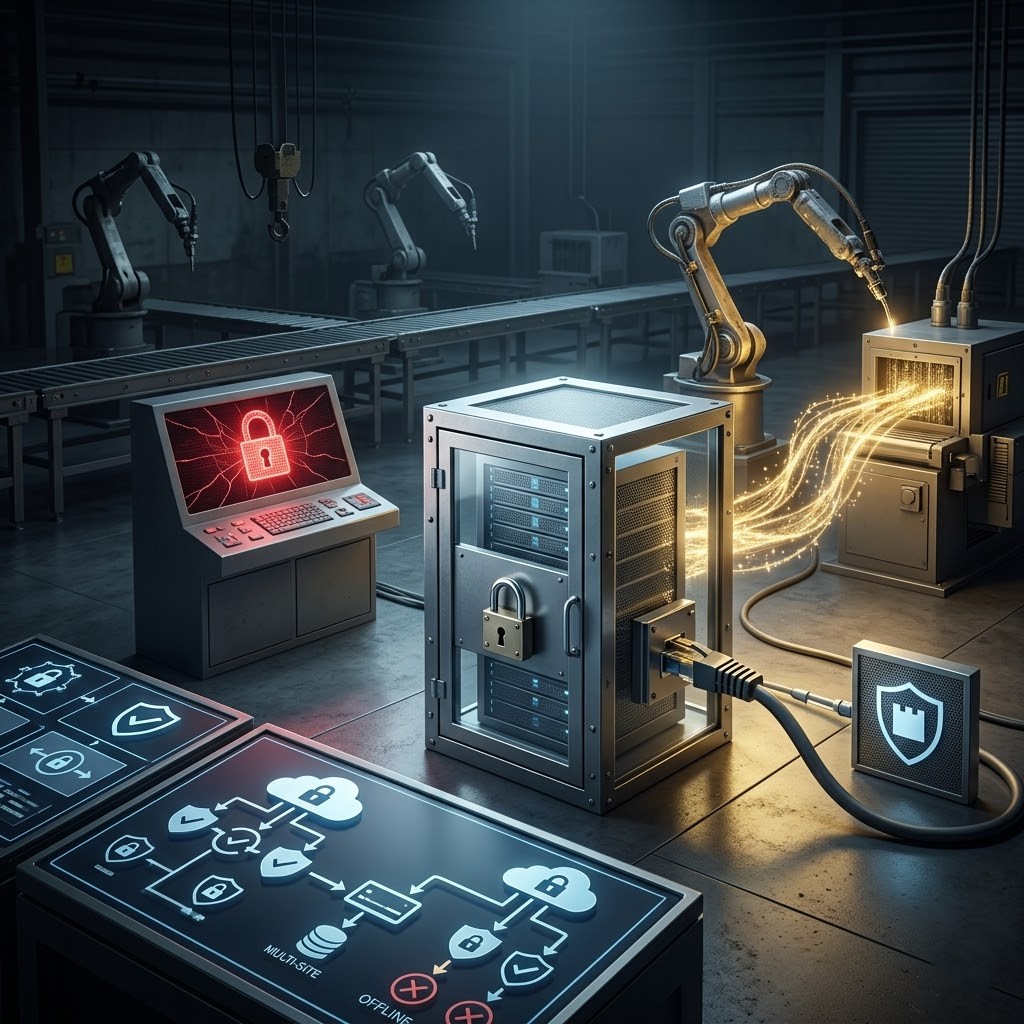
Imagine walking onto the facility floor on a random Tuesday morning. The robotic welding arms are completely still. The conveyor belts are silent. The human-machine interface screens, which normally display pressure gauges and production quotas, are locked out and showing a ransom note demanding millions in cryptocurrency.
This is not a hypothetical doomsday scenario. For modern manufacturing operations, it is a very real and present danger.
Ransomware syndicates have shifted their focus. They realized that holding data hostage is profitable, but holding physical production hostage forces an immediate crisis. When a hospital loses systems, lives are at stake. When a manufacturing plant loses its operational technology, millions of dollars are bled out by the hour. Supply chains collapse, vendor contracts are breached, and raw materials spoil.
Building a Business Continuity Plan for a manufacturing environment is fundamentally different from creating one for a corporate office. In an office, employees can fall back to using pen and paper or their personal mobile devices. On a factory floor, you cannot manually operate a precision CNC machine or a chemical mixing vat.
At CyLentrix, we have seen firsthand how the convergence of traditional IT networks and operational technology has expanded the attack surface for factories. This comprehensive guide will break down exactly how to architect a bulletproof Business Continuity Plan that prioritizes rapid recovery, limits operational downtime, and secures your legacy equipment against modern threats.
The Unique Vulnerabilities of the Manufacturing Sector
To defend the plant floor, you must first understand why it is so attractive to cybercriminals. The manufacturing sector deals with a unique set of technical debt and architectural challenges that do not exist in standard corporate environments.
The IT and OT Convergence Problem
Historically, Information Technology (IT) and Operational Technology (OT) lived in completely separate worlds. IT managed the emails, the accounting software, and the human resources databases. OT managed the programmable logic controllers, the supervisory control and data acquisition systems, and the industrial control systems. They were physically isolated from one another.
Today, that gap has closed. Management wants real-time data from the factory floor fed directly into their cloud-based enterprise resource planning software. Maintenance teams want remote access to troubleshoot machinery from home. This convergence means a phishing email clicked by someone in the payroll department can theoretically provide an attacker with a pathway to shut down a blast furnace.
The Burden of Legacy Equipment
In the software world, a five-year-old laptop is considered ancient. In the manufacturing world, a stamping press or a specialized milling machine might be expected to operate continuously for thirty years.
The software running these massive machines was often built decades ago. It is common to find critical infrastructure running on Windows XP or outdated Linux kernels. You cannot simply install a modern endpoint detection and response agent on a twenty-year-old machine without risking a system crash. Attackers know this. They know these legacy systems are unpatchable, making them prime targets for lateral movement once the network is breached.
A Low Tolerance for Downtime
Manufacturing operates on tight margins and strict “just-in-time” inventory models. Every minute of downtime translates directly to lost revenue. Threat actors target manufacturing specifically because the financial pressure to pay the ransom is immense. When a plant manager is looking at a loss of five hundred thousand dollars per day in halted production, a one million dollar ransom demand suddenly looks like a rational business expense.
Defining the Scope: IT Disaster Recovery vs. Business Continuity
Before diving into the technical strategies, we need to clarify our terminology. Many organizations use Disaster Recovery and Business Continuity interchangeably, but they are distinct disciplines.
Disaster Recovery is a subset of your overall strategy. It is highly technical. It focuses on how your IT and security teams will restore servers, recover databases from backups, and rebuild the network infrastructure after a catastrophic event.
Business Continuity is the overarching operational umbrella. It answers the question of how the business survives while the IT team is performing the disaster recovery. A BCP dictates how to communicate with vendors, how to reroute supply chains, how to manage public relations, and how to keep the company solvent while the digital fires are put out.
For a BCP to be effective, it cannot be drafted in a silo by the IT department. It requires input from the plant manager, the chief financial officer, legal counsel, and floor supervisors.
Step 1: Deep Asset Visibility and Network Segmentation
You cannot protect what you cannot see. The foundation of any ransomware defense strategy begins with complete visibility into every device connected to your network.
Mapping the Environment
Many facilities suffer from “shadow IT” and “shadow OT”. This happens when a floor manager connects a smart sensor to the network to monitor temperature, but never informs the security team. To build your BCP, you must conduct a rigorous physical and digital audit of every connected device.
You need to document:
- Every server and workstation.
- Every programmable logic controller.
- Every internet-of-things device and smart sensor.
- All remote access gateways used by third-party vendors.
Enforcing the Purdue Model
Once you have an inventory, you must segment the network. The gold standard for manufacturing network architecture is the Purdue Enterprise Reference Architecture model.
The Purdue Model breaks the manufacturing environment into distinct logical zones. The corporate IT network sits at the top levels. The industrial control systems sit at the bottom levels. Between these zones, you place industrial firewalls and demilitarized zones.
If ransomware infects the corporate network, proper segmentation ensures the malicious code hits a dead end at the firewall before it can cross over into the operational technology zone. Network segmentation contains the blast radius of an attack, turning a potential company-wide shutdown into a localized IT headache.
Step 2: Architecting Immutable Backups
When ransomware strikes, your backups are your only lifeline. However, ransomware operators have evolved. They no longer just encrypt your primary data. Modern variants are specifically programmed to seek out your backup servers and encrypt or delete those files first. If your backups are compromised, you have no leverage.
The 3-2-1-1 Backup Rule
To guarantee recovery, manufacturing facilities must upgrade from traditional backup schedules to the 3-2-1-1 methodology.
- Three: Maintain at least three copies of your critical data. This includes your primary production data and two backup copies.
- Two: Store these backups on two different types of storage media. For example, use a local network-attached storage device for one copy and a cloud-based repository for the other.
- One: Keep at least one copy strictly offsite to protect against physical disasters like fires or floods at the primary facility.
- One: Keep at least one copy immutable and air-gapped.
The Power of Immutability
An immutable backup is a file that cannot be altered, encrypted, or deleted by anyone for a set period. Even if a cybercriminal steals the credentials of your highest-level system administrator, they cannot modify an immutable backup.
Air-gapping takes this a step further by physically disconnecting the backup storage from the network. If there is no network path to the storage drive, the ransomware cannot reach it. Deploying immutable, air-gapped backups is the single most critical step in ensuring your BCP actually works when you need it.
Step 3: Establishing RTO and RPO for the Production Line
A Business Continuity Plan is built on mathematical realities. You must calculate two critical metrics to guide your recovery efforts.
Recovery Point Objective (RPO)
RPO measures your maximum tolerable data loss. It answers the question: how far back in time can we afford to lose data?
If your facility manufactures high-volume consumer packaged goods, losing four hours of production logs, shipping manifests, and inventory tracking might create total chaos. In this scenario, your RPO might be measured in minutes, requiring continuous replication of your databases. If you manufacture bespoke, heavy machinery where production moves slowly, an RPO of twenty-four hours might be perfectly acceptable.
Recovery Time Objective (RTO)
RTO measures your maximum tolerable downtime. It answers the question: how quickly do these systems need to be back online before the business suffers irreversible damage?
Not all systems are created equal. Your BCP must categorize assets into tiers to prioritize recovery.
|
Asset Tier |
Description |
RTO Target |
Example Systems |
|
Tier 1 (Mission Critical) |
Systems required to keep the business alive and safe. |
Under 4 Hours |
Active Directory, OT Firewalls, Core ERP. |
|
Tier 2 (Business Essential) |
Systems required to resume basic manufacturing operations. |
12 to 24 Hours |
Inventory Management, Vendor Portals, Email. |
|
Tier 3 (Non-Essential) |
Systems that optimize work but are not strictly necessary for production. |
3 to 7 Days |
Historical Data Archives, Marketing Servers. |
When an attack occurs, your engineering team will use this tiered structure to avoid wasting time restoring low-priority systems while the core production line remains offline.
Step 4: The Incident Response Playbook
Chaos is the enemy of recovery. When the red screens appear, panic sets in. A well-documented Incident Response Playbook removes the need for decision-making during a crisis. It provides a step-by-step checklist of actions to contain the threat and initiate the BCP.
Phase 1: Detection and Verification
The first step is confirming that an attack is actually happening. A malfunctioning sensor could look like sabotage, but it might just be a hardware failure. Your IT team or your Managed Security Service Provider must quickly verify the presence of malicious activity and identify the scope of the infection.
Phase 2: Immediate Containment
Do not turn off the infected machines. Unplug them from the network instead.
Pulling the power cord destroys volatile memory (RAM), which forensic investigators need to understand how the attackers got in and what data they accessed. By disconnecting the ethernet cable or disabling the switch port, you stop the ransomware from spreading laterally across the floor while preserving the crime scene.
If the infection is spreading rapidly, the playbook must grant a specific individual the authority to sever the main internet connection and completely isolate the OT network from the IT network.
Phase 3: Communication and Stakeholder Management
During an outage, rumors spread faster than the virus. Your BCP must outline exactly who speaks to whom.
- Internal Communications: How do you tell the floor workers to stop production without causing panic? Do you have an out-of-band communication method like a dedicated emergency texting service, since corporate email will likely be down?
- External Communications: Who is authorized to speak to the media? When do you notify your vendors that shipments will be delayed?
- Legal and Regulatory: Depending on your jurisdiction and the type of data compromised, you may have strict legal deadlines to notify government authorities or customers about a data breach.
Step 5: The Legal and Financial Realities of Ransomware
A critical, often overlooked component of business continuity is the financial and legal fallout. Recovering the servers is only half the battle.
Cyber Insurance Protocols
If your manufacturing firm carries cyber liability insurance, your BCP must explicitly state the protocols for engaging them. Many insurance policies mandate that you contact their approved incident response firm before you touch your own servers. If your internal IT team starts deleting files and restoring backups without the insurer’s permission, you risk voiding your coverage entirely.
The Ransom Dilemma: To Pay or Not to Pay
Your BCP should outline a framework for the most difficult conversation your executive board will ever have. Should you pay the ransom?
Law enforcement strongly advises against paying. Paying funds future criminal enterprises and there is absolutely no guarantee that the attackers will actually provide the decryption key. Furthermore, if the attackers are located in a sanctioned region, paying the ransom could result in severe federal fines for your company.
However, from a pure business continuity perspective, leaders sometimes view the ransom as the lesser of two evils when faced with weeks of total downtime. The BCP must designate a specialized crisis committee to weigh the legal risks against the operational reality, and outline the process for engaging professional ransomware negotiators if necessary.
Step 6: Securing the Supply Chain and Third-Party Risk
Modern manufacturing relies heavily on deeply integrated supply chains. Your facility might be perfectly secure, but what happens if your primary logistics provider or raw material supplier gets hit by ransomware?
A resilient BCP extends beyond your own four walls. You must evaluate the security posture of your critical vendors.
If your packaging supplier goes offline for two weeks, your finished goods will pile up on the warehouse floor until production halts. Your BCP must include alternative sourcing strategies. Maintain contracts with secondary vendors who can step in immediately if your primary supply chain is compromised. Segment your network so that third-party vendors accessing your systems via virtual private networks have strictly limited permissions, preventing an infection on their end from bleeding into your facility.
Step 7: Continuous Testing Through Tabletop Exercises
A Business Continuity Plan is entirely useless if it just sits in a binder on the plant manager’s desk gathering dust. The infrastructure changes, personnel turn over, and the threat landscape evolves constantly.
To ensure your BCP is bulletproof, you must stress-test it regularly through tabletop exercises.
A tabletop exercise is a simulated cyberattack. You gather the key stakeholders in a conference room and a facilitator throws a hypothetical scenario at them.
- “It is 2:00 AM on a Saturday. The night shift supervisor reports that all robotic assembly arms have stopped responding and the HMI screens are locked. The primary database server is unreachable. What is your first move?”
As the team works through the scenario, the facilitator injects new complications.
- “The press is calling for a statement.”
- “We just realized the local backups are also encrypted.”
- “The cyber insurance broker is not picking up the phone.”
These exercises expose the gaps in your plan before a real crisis hits. You might discover that the person assigned to authorize a network shutdown is currently on a two-week vacation in an area with no cell service, and no alternate authority was designated. Finding these flaws during a simulation is a learning opportunity. Finding them during a live ransomware attack is a career-ending disaster.
How CyLentrix Fortifies Manufacturing Resilience
We understand that managing the complexities of OT network segmentation, immutable backups, and continuous threat monitoring is an overwhelming task for internal IT teams already stretched thin by daily helpdesk tickets.
At CyLentrix, we specialize in translating these complex security requirements into actionable, deployed architecture for the manufacturing sector.
We do not just hand you a generic template. We integrate deeply with your operations to map your unique legacy equipment, deploy hardware-level segmentation, and implement rigorous, air-gapped Disaster Recovery as a Service solutions. Our 24/7 Managed Security Operations Center monitors the boundaries between your corporate IT and factory OT, hunting for behavioral anomalies that signal an impending attack long before the encryption process begins.
Building a bulletproof Business Continuity Plan is a massive undertaking, but the alternative is simply unacceptable in today’s threat landscape.
Securing the Future of Production
Ransomware is no longer just a technology problem. It is a fundamental threat to business survival. The manufacturing sector cannot afford to rely on outdated perimeter defenses and hope for the best. Hope is not a strategy.
By mapping your environment, enforcing strict segmentation, locking down immutable backups, and practicing your response protocols, you transform your organization from a soft target into a hardened facility. The goal of a bulletproof Business Continuity Plan is not to prevent every single alert or intrusion. The goal is to ensure that when the worst does happen, your production lines are back up and running before your competitors even know you were attacked.
Take the time to evaluate your current recovery strategies today. Ensure your backups are truly isolated. Test your communication plans. The survival of your manufacturing operations depends entirely on the preparations you make right now, while the machinery is still running and the screens are still green.