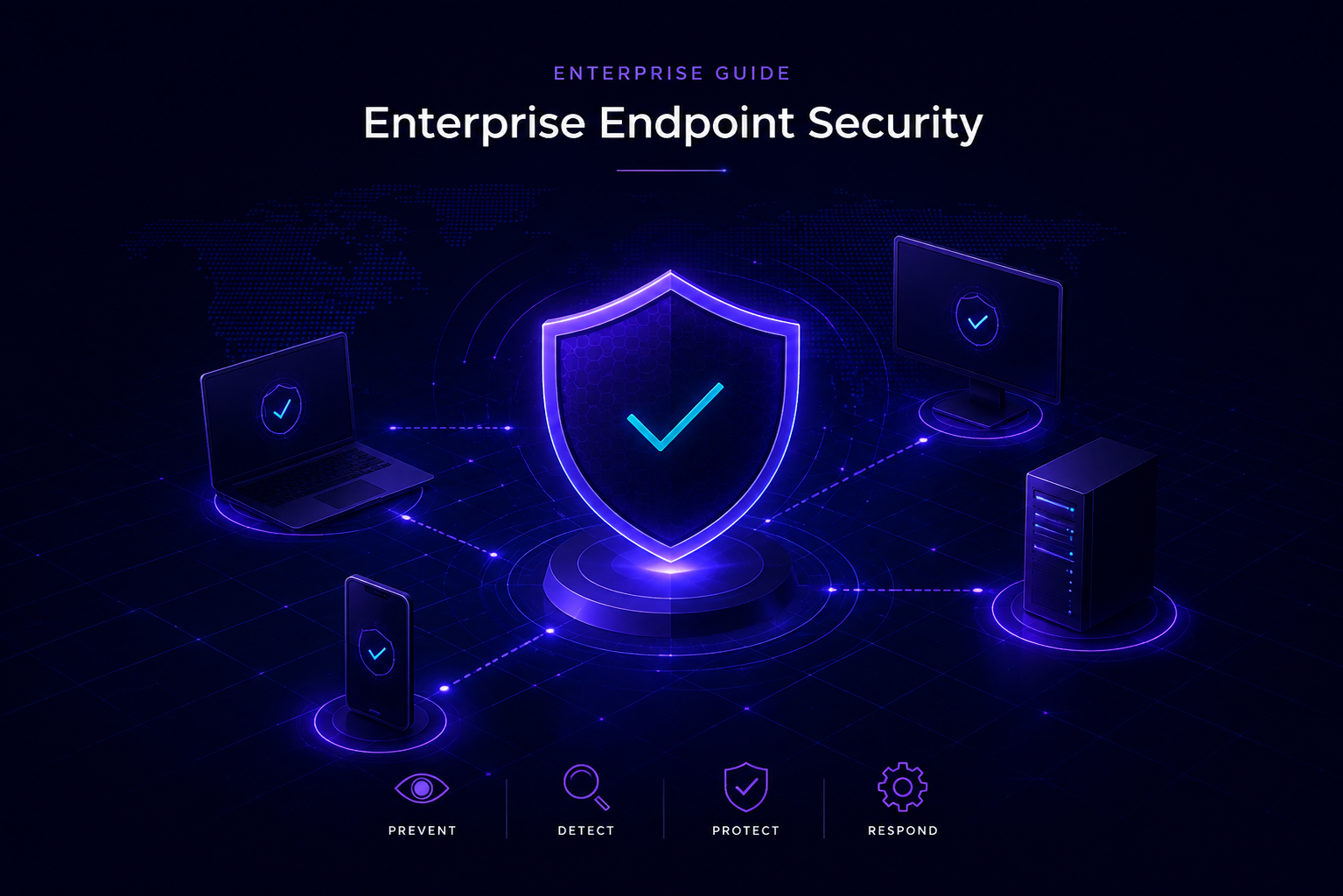

Protect laptops, desktops, servers and other endpoints with continuous visibility, behavioral threat detection and rapid response capabilities designed to identify and contain modern cyber threats. Cylentrix delivers Endpoint Security and EDR services that surface malware, ransomware and suspicious endpoint activity early, support investigation of what actually happened, and contain affected devices before an incident spreads.
Endpoint Security protects the device. EDR records what happens on it. Together they give security teams the visibility to detect, investigate and respond to threats that reach the endpoint.
Endpoints are where people, data and applications meet, which makes them the most common entry point into an enterprise. Malware, ransomware, credential theft, phishing payloads, malicious applications, unauthorised access and lateral movement almost always begin on a device somebody is using.
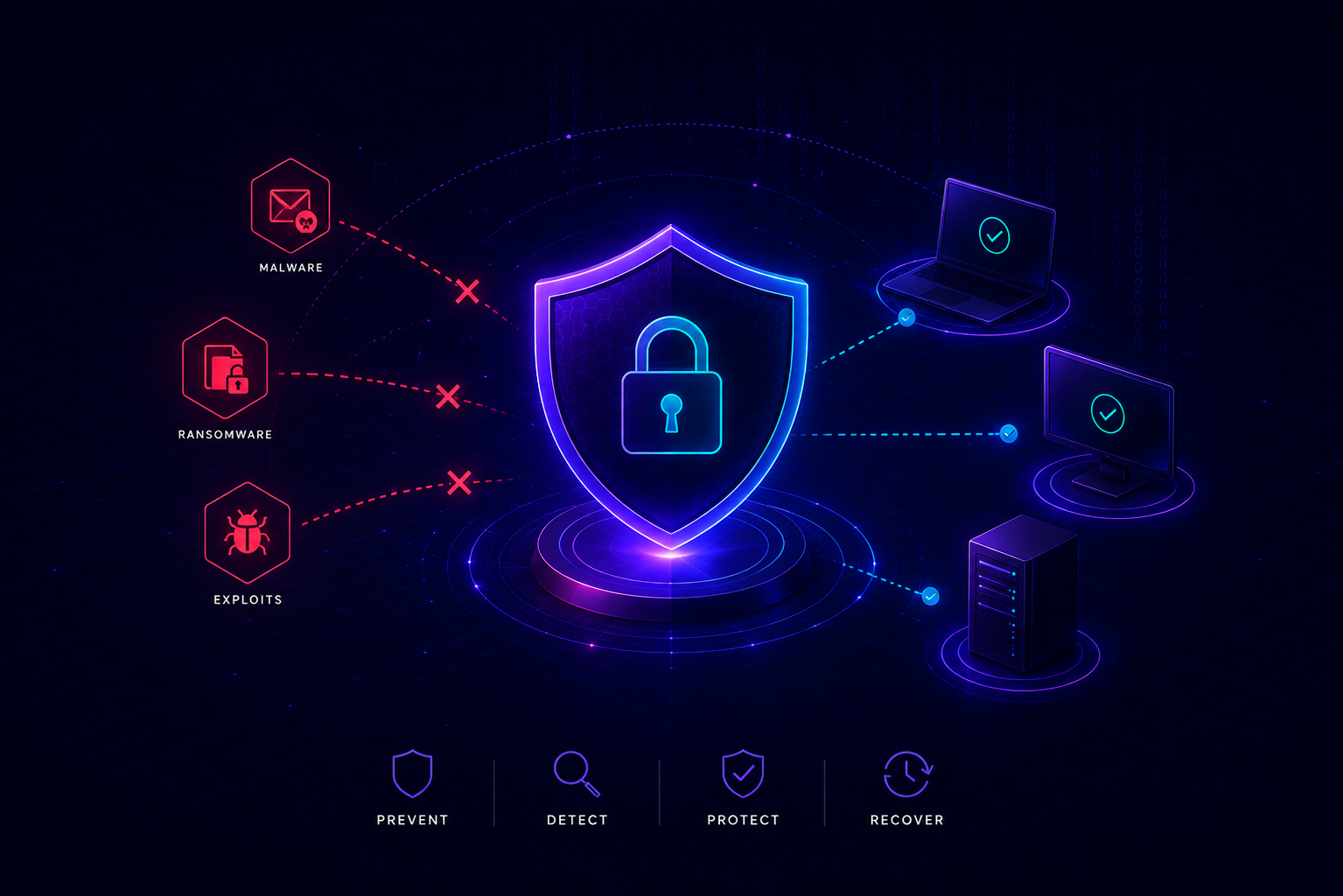
Endpoint protection blocks what is already known to be malicious. Endpoint Detection and Response adds what matters next: continuous recording of endpoint activity, behavior-based detection of the activity a signature would miss, and the investigation and response capability a security team needs to act on it quickly.
Endpoint activity is recorded continuously, so security teams can see what ran, when and under which user.
Suspicious sequences of behavior are flagged even when the file, script or tool involved has never been seen before.
Process chains, files, users and connections are traceable, turning an alert into an understood sequence of events.
Affected endpoints can be isolated and remediated so a single compromised device does not become an enterprise incident.
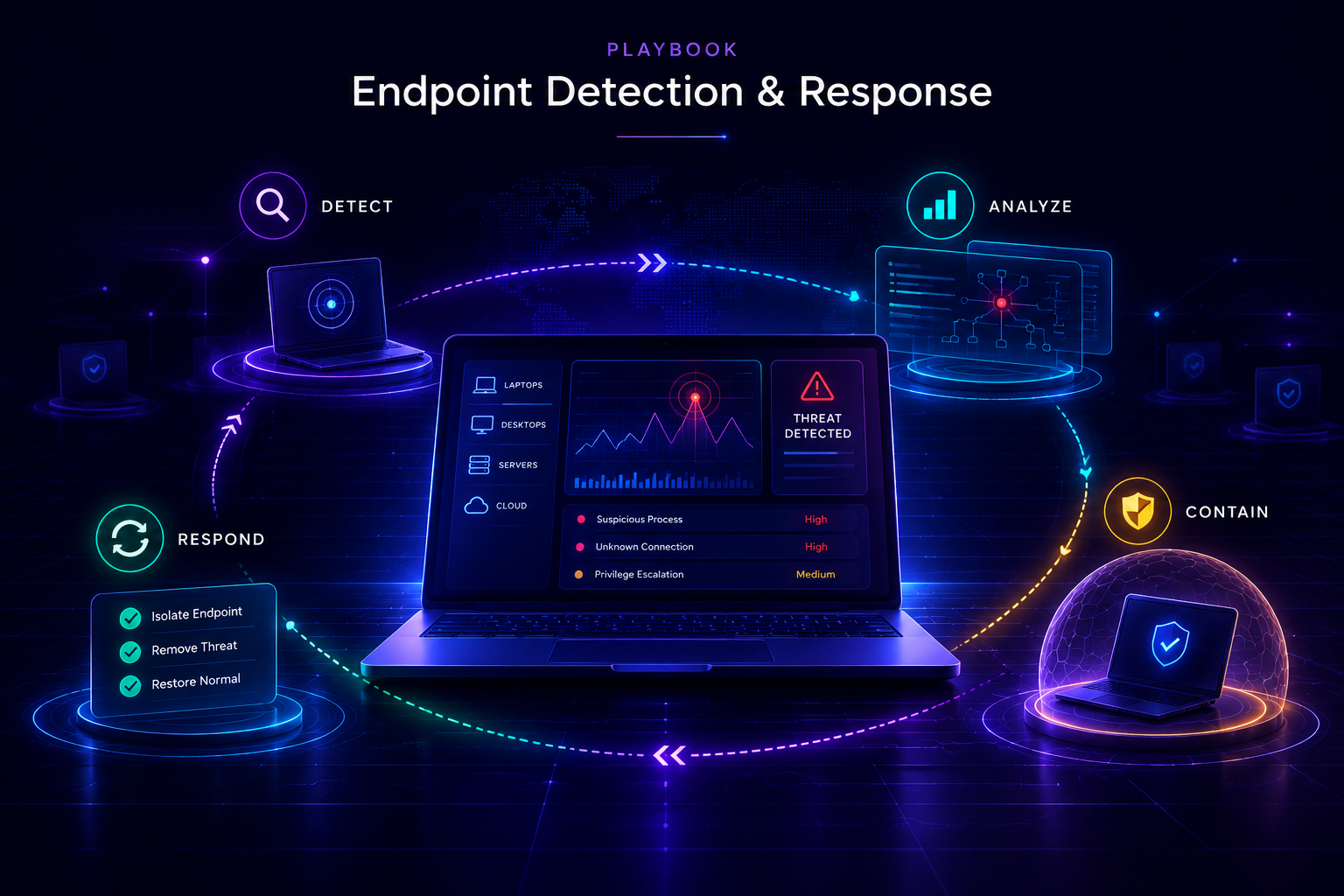
EDR turns raw endpoint telemetry into a decision. Activity is collected, analyzed and detected on, then investigated, contained and resolved.
Endpoint telemetry collected
Users, processes and applications generate activity on every device.
Lightweight agents record endpoint telemetry continuously.
Activity is correlated and compared against known and abnormal behavior.
Suspicious behavior and indicators of compromise raise a detection.
Analysts trace the processes, files, users and connections involved.
Affected endpoints can be isolated to stop a threat spreading further.
Malicious processes and artefacts are removed and access is revoked.
The endpoint is restored, hardened and returned to normal operation.
What endpoint detection and response actually gives a security team: the sequence of events, the affected device, and a way to stop it.
Endpoint behavior that deviates from normal is surfaced as a detection, not left in a log.
Recorded telemetry shows what executed, under which account, and in what order.
Parent and child processes, file writes and outbound connections are followed end to end.
Files, hashes, registry changes and network indicators are captured for hunting across the estate.
A compromised device can be cut off from the network while remaining reachable for investigation.
Artefacts are removed, credentials rotated and the endpoint is returned to a trusted state.
Wherever a device holds patient records, payment data, production control or citizen services, the endpoint is the objective. Cylentrix designs endpoint protection around how each industry actually works.
Engineering laptops, shop-floor terminals and production servers sit beside OT.
Clinical workstations and imaging terminals carry the data ransomware targets.
Branch endpoints and privileged workstations are prime targets for credential theft.
Developer laptops hold source code, keys and client access, often off-network.
Shared lab machines and faculty laptops on open networks need malware detection.
POS terminals and back-office systems handle payment data across many sites.
Warehouse terminals, handheld scanners and hub workstations run continuously.
Departmental desktops and service counters hold records needing audit-grade visibility.
Servers, jump hosts and management workstations are where lateral movement starts.
Front-desk PMS terminals and payment devices sit in public, high-turnover areas.
Endpoint security is only as good as the team operating it. Cylentrix combines cybersecurity, managed IT and telecom engineering, so detection is designed around the infrastructure it runs on.
The people securing your endpoints also understand your network, identity and infrastructure — no handoff between vendors when something moves fast.
Laptops, desktops, servers, remote devices and branch endpoints are covered under one view rather than several disconnected consoles.
Detection engineering tuned to your environment, so behavioral alerts reflect how your users and applications actually operate.
Deployment, policy tuning, monitoring and continuous improvement of your EDR platform run as an ongoing managed service.
Regular hunts across endpoint telemetry look for indicators of compromise and quiet activity that has not yet triggered an alert.
When a detection becomes an incident, the same team investigates, contains, remediates and documents what happened.
Endpoint detections feed your wider security operations and SIEM workflows instead of sitting isolated in a separate tool.
Rollouts account for servers, VDI, branch sites, bandwidth and change windows, so agents land without breaking operations.
Distributed delivery across three regions supports enterprises with endpoints and users spread across multiple time zones.
Cylentrix deploys and operates endpoint protection and EDR platforms from established security vendors, selected to fit each environment rather than a single fixed stack.
Practical reading from the Cylentrix security practice for the people who will own endpoint detection, investigation and response.
Guide
What endpoint protection covers, where it stops, and how to structure coverage across laptops, desktops and servers.
Read the guide
Playbook
A working sequence for EDR detections: triage, investigation, containment, remediation and recovery.
Read the playbook
Ransomware
How ransomware reaches endpoints, the behaviors worth detecting early, and what containment looks like in practice.
Download the guideThe questions security and IT leaders ask before selecting an endpoint security and EDR service.
Endpoint Security is the protection of devices such as laptops, desktops, servers and other endpoints against malware, malicious files, unauthorised access and suspicious activity. It combines preventive controls on the device with policy enforcement, so known threats are blocked before they execute. It is the layer that protects the point where users, data and applications meet.
EDR stands for Endpoint Detection and Response. An EDR agent continuously records endpoint activity — processes, files, users, applications and network connections — and analyses it for suspicious behavior. When something is detected, EDR gives security teams the visibility to investigate what happened and the capability to respond, including isolating the affected endpoint.
Endpoint Security is mainly preventive: it blocks known malicious files and activity on the device. EDR is detective and responsive: it records endpoint activity, detects suspicious behavior that prevention missed, and supports investigation and containment. Most enterprises run both — endpoint protection to stop what is known, EDR to catch and respond to what is not.
EDR detects threats by analysing behavior rather than relying only on signatures. Endpoint telemetry is collected continuously and correlated to identify suspicious sequences: an unusual parent-child process chain, an unexpected script interpreter, abnormal file activity or an outbound connection to an unknown host. Detection rules, threat intelligence and AI-assisted behavioral analytics work together, and analysts validate what is raised.
Yes. EDR is designed to detect the behaviors associated with ransomware and malware — suspicious process execution, rapid or unusual file modification, attempts to disable recovery options and unexpected outbound communication. Because detection is behavior-based, EDR can surface activity from malware variants that no signature has seen yet, and support containment before it spreads.
Yes. EDR agents report to a cloud-managed platform, so endpoint monitoring continues whether the device is in the office, at a branch, at home or travelling. Remote and distributed endpoints are covered by the same detection logic and response capability, including the ability to isolate a device that is off the corporate network.
Yes. EDR detections and endpoint telemetry can be forwarded to a SIEM and consumed by SOC workflows, so endpoint activity is correlated with network, identity and cloud events. This gives analysts a single investigation timeline instead of a separate endpoint silo, and lets response actions be triggered as part of established security operations processes.
Cylentrix designs, deploys and operates endpoint security and managed EDR services for enterprises across India, USA and Singapore. That includes agent rollout across laptops, desktops and servers, detection tuning for your environment, continuous endpoint monitoring, threat hunting, investigation support and incident response — integrated with your wider security operations rather than run in isolation.
Gain deeper endpoint visibility, detect suspicious activity earlier and strengthen your response to endpoint-based cyber threats with Cylentrix.
Tell us about your endpoint estate and a Cylentrix security specialist will respond with next steps.