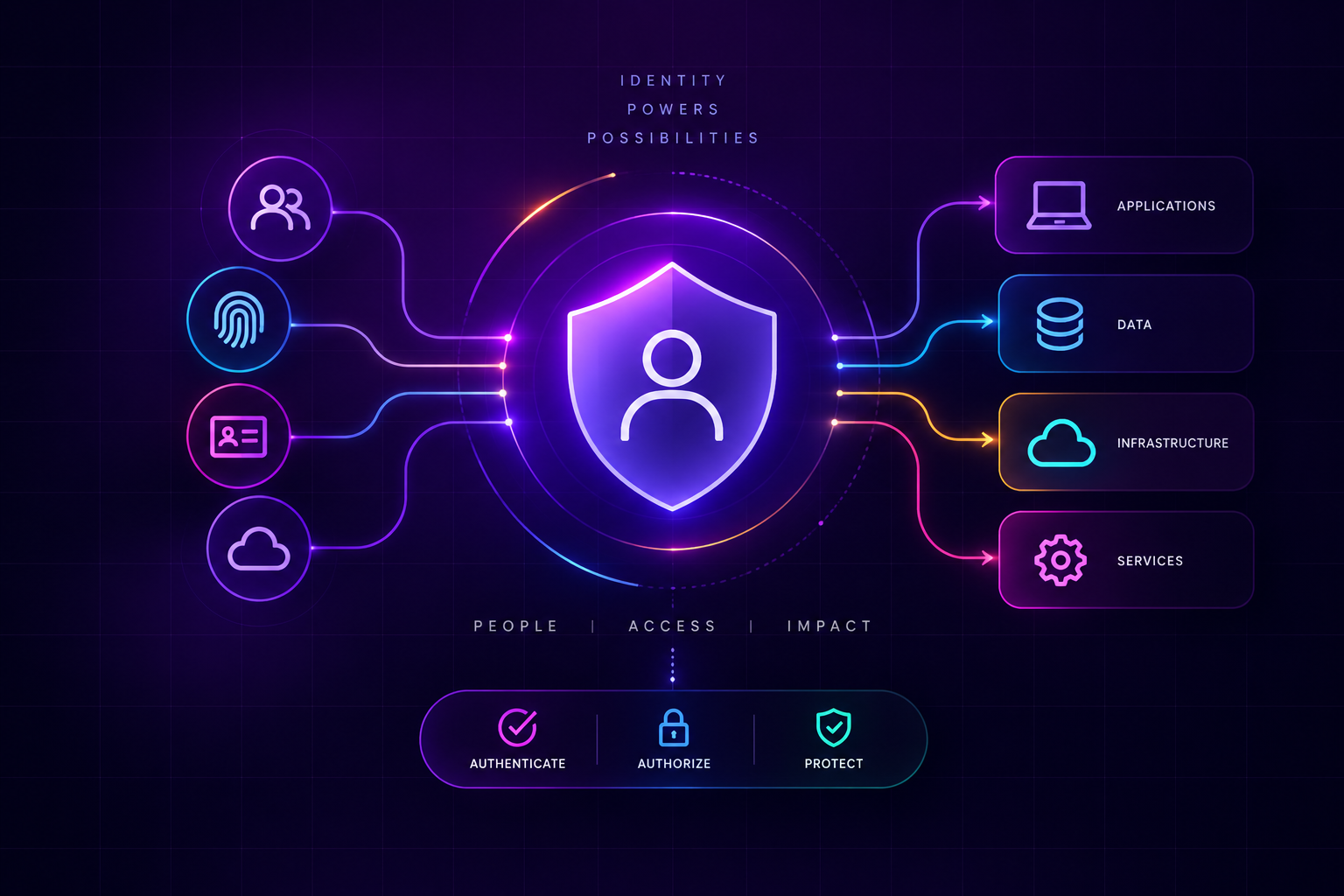

Secure workforce and application access with modern identity security controls that help organisations authenticate users, enforce least-privilege access and manage identities throughout their lifecycle. Cylentrix designs authentication, authorization and identity governance around your applications, your users and your security policy.
Identity & Access Management controls who can reach your applications, systems and data, and what they can do once inside. Cylentrix delivers it end to end — authentication, authorization, provisioning, privileged access and governance — on the identity platforms your environment already runs.
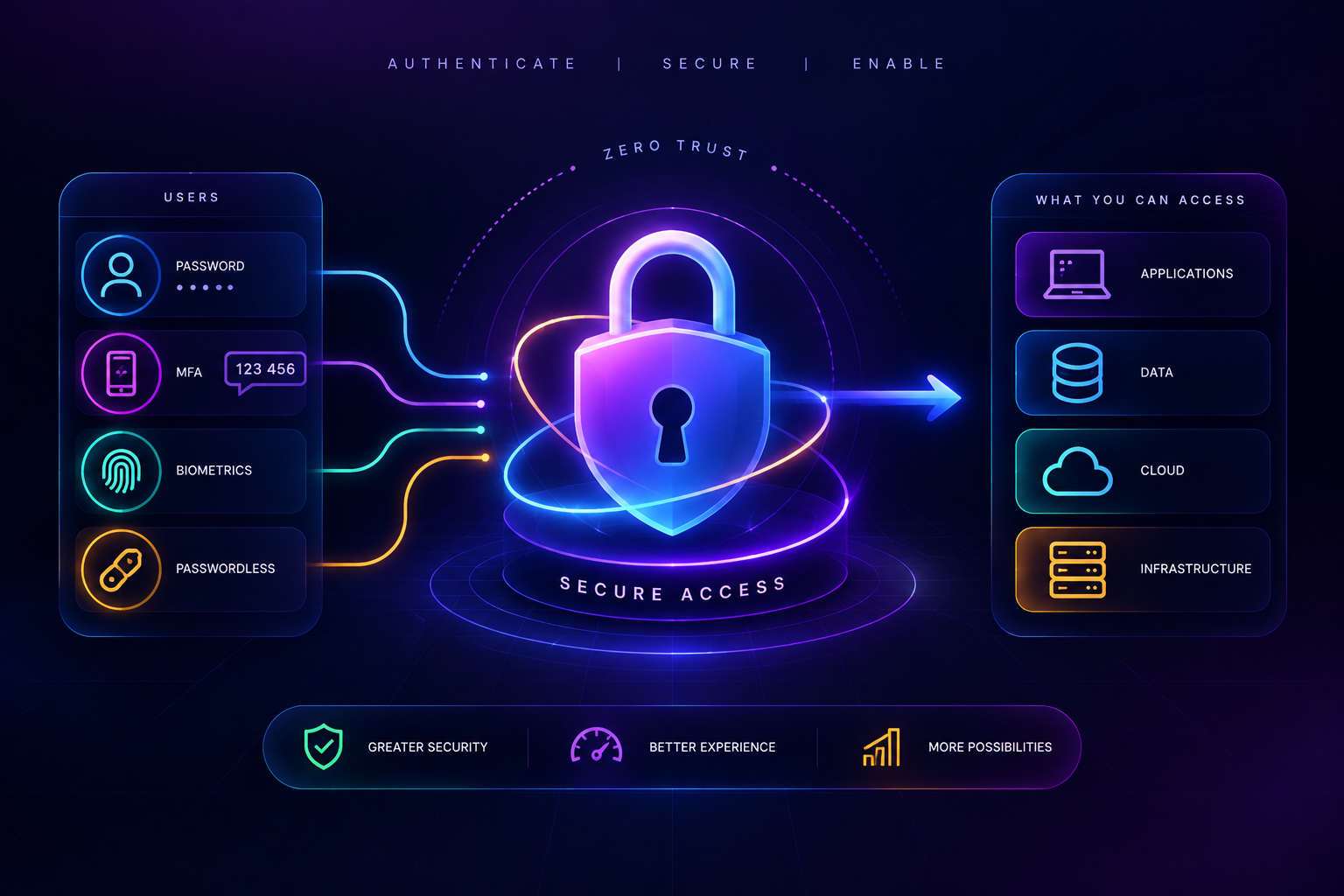
Simplify secure access to approved applications through centralized authentication with one consistent policy.
Add stronger verification beyond passwords to help protect user identities, prioritised by application sensitivity.
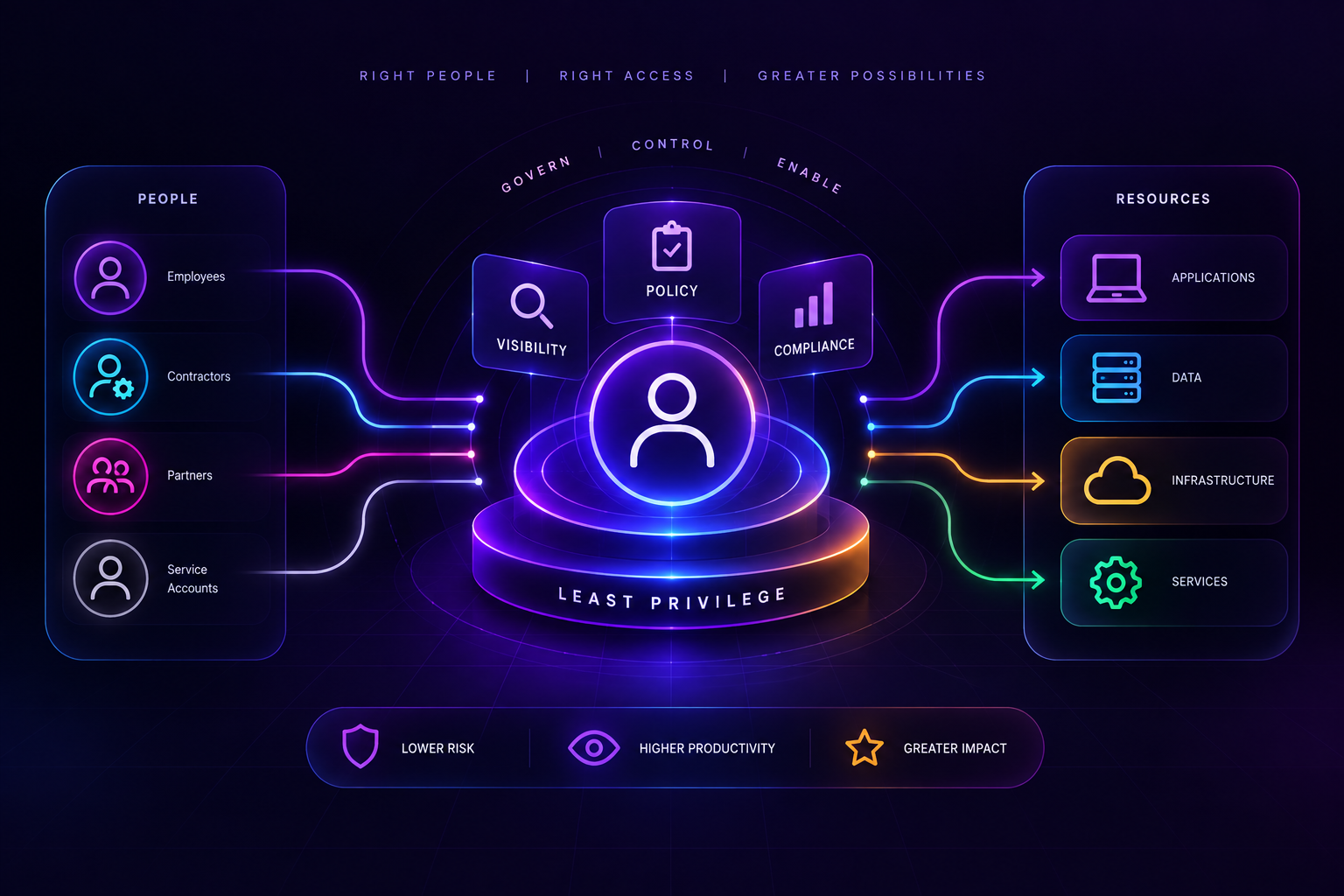
Align access permissions with job responsibilities and business roles so entitlements stay consistent and explainable.
Manage identity creation, changes and removal across the full user lifecycle, driven by HR and business events.
Help ensure users receive appropriate access on day one and lose it promptly when it is no longer required.
Strengthen controls around administrator and high-privilege accounts, including elevation, approval and session oversight.
Review permissions on a defined cadence and identify unnecessary or inappropriate access before an auditor does.
Apply identity and access policies consistently across business applications, SaaS platforms and cloud services.
IAM is not a one-time login. Each request is verified, authorized against policy, granted at the right scope, then monitored and reviewed, so access stays correct long after it was first approved.
The user is matched to an authoritative identity record and its current status.
Credentials plus MFA confirm the user is who the identity claims to be.
Access policy and role entitlements decide what this session is permitted to do.
The application, cloud service or dataset is opened at the approved scope only.
Authentication and access activity is logged and watched for unusual behaviour.
Entitlements are re-validated on a cycle, and anything unjustified is revoked.
Evaluated on every access request
Access is granted for a session, not forever
Good identity controls pay back on two fronts: they close the gaps attackers use most, and they take manual account work off IT. These are the outcomes enterprises see first.
MFA and single sign-on cut the value of a stolen or reused password, closing the most common route into an environment.
One sign-in to every approved application means less login friction and fewer password-reset tickets for the service desk.
Role-based permissions keep access proportionate to the job, so no one quietly accumulates rights they never needed.
Access reviews, approvals and provisioning records are captured as they happen, ready when an auditor or regulator asks.
Contractors, vendors and partners receive scoped, time-bound access that expires instead of lingering after the work ends.
Joiner, mover and leaver workflows replace manual account creation and clean-up across every connected system.
Wherever workforces rotate, contractors come and go, and regulators ask who had access to what, identity governance carries the weight. Cylentrix designs IAM for those environments.
Plant staff, contractors and vendor engineers need scoped access to MES and ERP across rotating shifts.
Clinical teams rotate between departments, so record access must follow the role, not the person.
Segregation of duties, maker-checker controls and evidenced access reviews sit at the centre of every audit.
Delivery teams span client environments, so project access must be granted fast and withdrawn at closure.
Students, faculty and researchers arrive each term, so identities are created and retired at scale.
Store-level turnover and shared point-of-sale logins make joiner-leaver discipline a daily concern.
Warehouse crews, drivers and partners reach the same WMS platforms from many sites and devices.
Departmental portals need authenticated access with a clear record of who approved which permission.
Remote hands, vendor engineers and administrators hold elevated rights needing approval and time limits.
Front desk, housekeeping and seasonal staff share systems, so access should follow the shift and role.
IAM touches security, IT operations and the people who have to use it every morning. Cylentrix works across all three, so access controls hold up in production rather than only on a design document.
Identity sits between security policy, IT operations and the network. We run all three practices, so access design accounts for how your environment is actually built and supported.
Workforce identity, contractors, service accounts and shared operational logins each behave differently. We design for the whole population, not just full-time employees.
Role models, entitlement structures and approval paths built from how your business is organised, so least privilege is maintainable instead of theoretical.
SSO federation, MFA rollout and conditional access policies implemented with a migration plan that does not lock out the business on go-live day.
Joiner, mover and leaver workflows connected to HR and IT processes so provisioning and deprovisioning happen on time and leave an audit trail.
Discovery of privileged accounts, credential protection, approval-based elevation and session oversight for the accounts that matter most.
Consistent identity policy across on-premises applications, SaaS platforms and cloud consoles, so access rules do not fragment per system.
Identity events shared with SOC, SIEM and endpoint tooling where those exist, so access anomalies are investigated in context rather than in isolation.
Delivery and support across three regions, useful when identity spans multiple entities, time zones and local data requirements.
Cylentrix implements identity and access controls on established enterprise identity platforms, selected per environment on fit, existing investment and operational practicality.
Microsoft Entra
Workforce identity, single sign-on and conditional access policy
Okta
Identity provider for SSO, adaptive MFA and user lifecycle management
CyberArk
Privileged access management and credential protection for elevated accounts
Ping Identity
Enterprise authentication, federation and access orchestration
Practical reading from the Cylentrix security practice for IT and security leaders planning an identity programme.
Buyer's Guide
Scoping an IAM programme: identity sources, role design, application onboarding order and what to sequence first.
Read the guide
Governance
Running access reviews that people complete, cleaning up entitlement sprawl and keeping least privilege in place afterwards.
Read the guide
Playbook
Rolling out SSO and MFA across a mixed application estate, including exceptions, legacy systems and break-glass planning.
Download the playbookThe questions security and IT leaders ask before starting an IAM programme, answered the way our identity engineers answer them.
Identity & Access Management (IAM) is the set of policies, processes and technologies that control who can access an organisation's applications, systems and data, and what they are allowed to do once they have access. IAM covers identity creation, authentication, authorization, role and permission assignment, privileged access control, access reviews and the removal of access when it is no longer required.
Most enterprise resources are now reached through a login rather than a physical location, so the identity is the practical security perimeter. Compromised credentials, excessive permissions and accounts that were never removed are common routes into an environment. IAM reduces that exposure by verifying users, limiting permissions to what each role requires, and governing access over time.
Authentication confirms who a user is, for example through a password combined with a second factor. Authorization decides what that verified user is permitted to do, such as which applications they can open and which records they can view or change. Authentication happens first; authorization is applied on every access request that follows.
Single Sign-On (SSO) lets a user authenticate once with a central identity provider and then reach the applications they are approved for without logging in separately to each one. SSO reduces password reuse and login friction, and gives security teams one consistent place to apply authentication policy and review access.
Multi-Factor Authentication (MFA) requires more than one form of verification, typically something the user knows plus something they have or something they are. Because a stolen or guessed password alone is not enough to complete the login, MFA significantly raises the difficulty of account takeover, particularly for remote access, administrative accounts and cloud applications.
Role-Based Access Control (RBAC) assigns permissions to roles that reflect job responsibilities, and then assigns users to those roles rather than granting permissions individually. This keeps access consistent across a team, makes least privilege easier to maintain, and simplifies changes when someone joins, moves or leaves.
Privileged Access Management (PAM) applies stronger controls to accounts with elevated rights, such as administrators, service accounts and break-glass accounts. Typical PAM controls include discovering privileged accounts, securing their credentials, granting elevated access only when needed and for a limited period, recording privileged sessions and reviewing that access regularly.
Cylentrix works with enterprises to design and implement identity and access controls around their applications, users and security policies. That includes access policy and role design, single sign-on and multi-factor authentication rollout, joiner-mover-leaver provisioning workflows, privileged access controls, access review processes, and integration with the wider security and IT environment across India, USA and Singapore.
Strengthen authentication, control access and reduce identity-related risk with an IAM strategy designed around your users, applications and business environment. Identity also underpins our Zero Trust architecture, Managed SOC and wider cybersecurity services.
Tell us what you are working with — the applications, the user population, the access problems you already know about — and we will come back with a practical starting point.
No obligation and no scripted pitch. A Cylentrix identity engineer reviews what you send and replies with an honest read on scope, sequence and effort.